Around 4,500 years ago, while most of the world lived in small farming villages, a city rose on the banks of the Indus with straight streets laid out on a grid, houses connected to covered drains, and hundreds of wells. Its name today is Mohenjo-daro — Sindhi for “Mound of the Dead Men” — and it was one of the largest cities of the Indus Valley Civilization, among the world’s earliest urban cultures. Here’s what the ruins tell us, and what they still refuse to explain.
A city rediscovered in 1922
Mohenjo-daro, in present-day Sindh, Pakistan, was first excavated in 1922 by R. D. Banerji of the Archaeological Survey of India — one of the great archaeological discoveries of the 20th century. The city flourished roughly between 2600 and 1900 BCE, at its peak home to an estimated 35,000 to 40,000 people. In 1980 it became one of the first sites ever inscribed on the UNESCO World Heritage List.
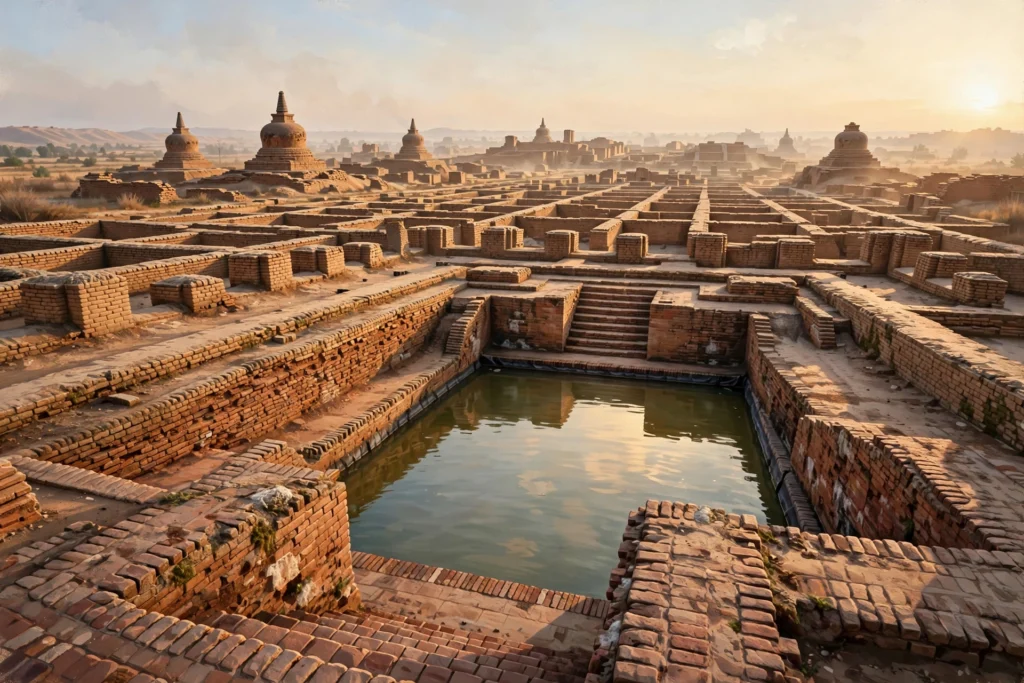
What stunned the excavators was the planning. Streets were laid out in a grid. Houses — many two storeys high, built of standardized baked bricks — connected to a city-wide drainage system. Almost every house had a bathing area, and wastewater flowed through covered drains to soak pits. For comparison, large parts of European cities would not manage covered sewerage for another three thousand years.
The Great Bath
The site’s most famous structure is the Great Bath: a watertight rectangular pool about 12 metres long, 7 metres wide and 2.4 metres deep, sealed with bitumen and surrounded by rooms — one containing a well that likely fed it. Scholars believe it was used for ritual bathing, though no temple or palace has ever been found at Mohenjo-daro. That absence is itself a clue: this was a city that invested its grandest architecture in public waterworks rather than monuments to kings.
The Dancing Girl and the Priest-King
Two small artifacts found at Mohenjo-daro are world-famous. The Dancing Girl, a 10.5 cm bronze statuette cast by the lost-wax method around 2500 BCE, shows a young woman in a confident pose, arm stacked with bangles — proof of extraordinary metalworking skill. The Priest-King, a steatite bust of a bearded man wearing a trefoil-patterned robe, has become the popular face of the Indus Civilization (though nobody knows who he actually was).
What we still don’t know
For all its streets and sewers, Mohenjo-daro guards big mysteries:
- The script is undeciphered. Thousands of short Indus inscriptions exist on seals and tablets, but the writing system has never been cracked — so the city’s own voice is silent.
- Nobody knows how it was governed. No palaces, no grand tombs, no clear depictions of rulers. Some scholars suggest a merchant oligarchy or collective governance — radically different from Egypt or Mesopotamia.
- The decline is debated. The old “massacre by invaders” theory has been largely abandoned. Current evidence points to climate shifts, changing river courses (the drying of the Ghaggar-Hakra system), and gradual de-urbanization around 1900 BCE.
Visiting today
Mohenjo-daro lies near Larkana in Sindh, about a day’s trip from Karachi or Hyderabad by road. The on-site museum displays artifacts including seals, pottery and jewelry. Go in the cooler months (October to March) — Sindh summers are brutal — and hire a local guide; the mounds and street grids make far more sense with someone who can read them.
Why it matters
Mohenjo-daro quietly rewrites the story of what early civilization looked like: not just pyramids and palaces, but plumbing, planning, and public baths. It is a reminder that the subcontinent’s urban history runs thousands of years deeper than most people imagine — and that some of humanity’s best ideas about how to build a city are very, very old.
How it was found: the 1922 discovery
For centuries, the mounds near Larkana were just part of the landscape. In the 1820s the traveller Charles Masson noted ancient ruins in the region, but nobody grasped what lay buried. The breakthrough came in 1922, when R. D. Banerji of the Archaeological Survey of India began excavating the largest mound — and uncovered streets, drains and houses of unmistakable antiquity.
The timing mattered. A year earlier, Daya Ram Sahni had begun digging at Harappa in Punjab. In 1924, Sir John Marshall, Director-General of the Archaeological Survey of India, announced to the world that these were not isolated ruins but two cities of a single, previously unknown Bronze Age civilization — contemporary with ancient Egypt and Mesopotamia, yet absent from every ancient text scholars had studied. It was one of the great archaeological surprises of the century: an entire urban civilization hiding in plain sight.
Excavations continued for decades — Ernest Mackay in the 1930s, Mortimer Wheeler in the 1940s–50s — each campaign refining the picture of a vast, sophisticated culture.
Mohenjo-daro and Harappa: the twin giants
Mohenjo-daro and Harappa anchor opposite ends of the Indus world: Harappa in Punjab to the north-east, Mohenjo-daro in Sindh to the south-west. Together with sites like Dholavira in Gujarat, Lothal with its remarkable dockyard, and Ganweriwala in the Cholistan desert, they belonged to a civilization covering well over a million square kilometres — geographically larger than Egypt and Mesopotamia combined at the time.
The twins shared the same DNA: grid streets, standardized baked bricks, covered drainage, the undeciphered script. But their modern fates diverged sharply. In the 19th century, Harappa’s ruins were heavily quarried — its ancient bricks carted off as ballast for the Lahore–Multan railway — leaving it far more damaged than Mohenjo-daro, which survived largely intact. That accident of history is a big reason Mohenjo-daro, not Harappa, became the popular face of the civilization.
The ruins are crumbling: the race to save Mohenjo-daro
Mohenjo-daro’s greatest enemy today is not looters but salt. Groundwater seeping upward through the soil carries dissolved salts into the baked bricks; when the water evaporates in Sindh’s fierce heat, the salts crystallize and flake the brickwork apart, grain by grain. Waterlogging from nearby irrigation has made the problem worse over the decades.
UNESCO and Pakistani authorities have run conservation campaigns for years — drainage works, brick treatment, protective capping — and archaeologists continue to warn that the site needs sustained intervention. It is a strange irony: a city whose engineers mastered water management 4,500 years ago is now being undone by water. Every visitor who walks its street grids is seeing something genuinely fragile — a reminder that heritage survives only as long as someone keeps fighting for it.
FAQ
Where is Mohenjo-daro located?
In Sindh, Pakistan, near the city of Larkana, on the west bank of the Indus River. It’s about a day’s road trip from Karachi.
How old is Mohenjo-daro?
The city flourished roughly 2600–1900 BCE, making its mature phase about 4,500 years old — contemporary with the pyramids of Egypt and the cities of Mesopotamia.
What does “Mohenjo-daro” mean?
“Mound of the Dead Men” in Sindhi. The original name the city’s inhabitants used is unknown, because the Indus script remains undeciphered.
What is the Great Bath?
A large watertight pool at Mohenjo-daro, sealed with bitumen and fed by a nearby well. It’s believed to have been used for ritual bathing, and it’s the earliest known public water structure of its kind.
Why did Mohenjo-daro decline?
There’s no single agreed answer. The leading explanations involve climate change, shifting river courses, and gradual de-urbanization around 1900 BCE — not a sudden invasion, as older theories claimed.
Is Mohenjo-daro a UNESCO World Heritage Site?
Yes — inscribed in 1980, among the very first sites ever listed.