
You’ve finally opened the book you meant to finish before your next meeting, class, or holiday. The deadline feels close, your phone keeps lighting up, and you’ve just reread a paragraph without taking it in. You don’t need another promise that you can race through every book. You need a way to move faster through the easy parts without missing what matters.
Learning how to read a book faster starts with choosing the right kind of attention. A thriller, a textbook, and a complicated argument shouldn’t get the same treatment. The useful target is understanding per unit of time, not an impressive timer result.
Table of Contents
- The Realistic Baseline Most Readers Start From
- A Three-Mode System for Skimming, Reading, and Studying
- A Four-Step Drill That Actually Builds Speed
- Matching Your Pace to the Book in Your Hand
- Reading Faster on Screens Without Losing Focus
- Three Speed-Reading Myths Worth Retiring
- Your Personal Reading-Speed Plan
The Realistic Baseline Most Readers Start From
A thick book can make an otherwise confident reader feel slow. You notice how much remains, start pushing your eyes forward, and then discover you can’t explain the passage you’ve just finished. The temptation is to assume your normal pace is the problem.
It may not be. A 2019 meta-analysis of silent-reading studies estimated average adult reading speed at approximately 238 words per minute, about 20% below the often-cited benchmark of 300 wpm. That’s a more realistic starting point than the spectacular rates advertised in speed-reading promotions.
The average isn’t a grade, either. If you’re reading unfamiliar vocabulary, tracing an argument, or enjoying carefully written dialogue, a slower pace can be an appropriate choice. You’re doing more than recognizing words. You’re connecting sentences and deciding what they mean.
Find your starting line without racing
Choose a representative passage from the book you want to finish. Don’t use an unusually easy opening if the rest contains technical explanations, and don’t measure a passage you already know.
Read comfortably with a stopwatch running, then close the book. Before checking the text, write a brief account of what you understood.
- Record the pace: Divide the number of words read by the minutes spent reading.
- Check the substance: Identify the main point, supporting details, and any important qualification.
- Note the conditions: Record whether you were tired, interrupted, or reading unfamiliar material.
- Keep the result: Save both the timing and your summary, rather than the speed alone.
If getting an exact word count is awkward in a printed book, use a countable digital excerpt for the timing test. Treat an estimated page count as a rough progress measure, not a precise reading-speed measurement.
Baseline rule: A faster result only counts as an improvement if you can still explain what you read.
Your starting line gives you something more useful than a comparison with another reader. It tells you what a successful session looks like for this book, under these conditions. That’s the standard to improve against.
A Three-Mode System for Skimming, Reading, and Studying
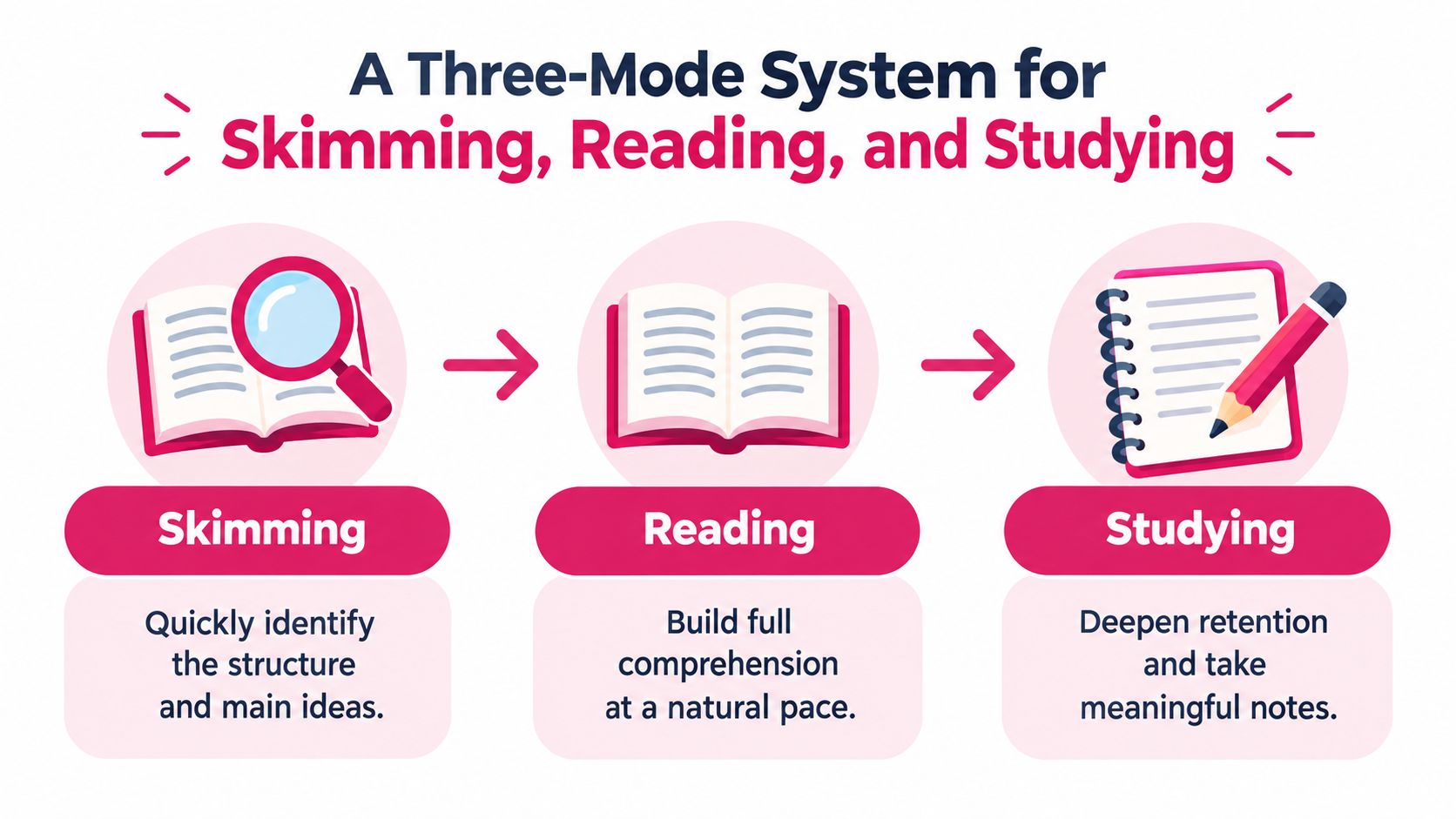
Don’t ask every pass through a chapter to do every job. Looking for structure, following an explanation, and examining its weaknesses are different tasks. Separating them lets you move quickly when an overview is enough and invest attention where understanding requires it.
Use this sequence as a set of options, not a requirement to read every chapter repeatedly.
Skim to establish the route
Before reading nonfiction, inspect the contents, headings, figures, definitions, and chapter summaries. Sample opening and closing paragraphs where they’re useful. Then write a question the chapter should answer, such as why the author recommends a particular approach or what evidence supports a claim.
Don’t turn the preview into a miniature study session. You’re identifying the route through the material, not trying to retain every detail before starting.
For fiction, preview more cautiously. Check chapter divisions or the opening situation, but avoid endings and summaries if you don’t want spoilers. A novel doesn’t need to become an information-extraction exercise.
Read for continuity, study for precision
During ordinary reading, follow the text at a comfortable pace. Mark selectively rather than stopping to produce polished notes.
- Definitions: Flag terms you’ll need to understand later passages.
- Claims and evidence: Distinguish what the author asserts from what they offer in support.
- Transitions: Notice when the author changes direction, introduces an objection, or draws a conclusion.
- Unresolved questions: Leave a compact marker where clarification is needed.
If an ambiguous sentence doesn’t block the next paragraph, continue and return later. If it contains the definition on which everything else depends, resolve it immediately.
Switch to close reading when you need to reconstruct reasoning, compare interpretations, or use the information accurately. That might mean working through an example, checking a qualification, or following a chain of causes rather than reading the passage again.
The trade-off matters. In a study summarized in a major review of speed-reading research, trainees reached about 400 wpm, but comprehension fell from 81% to 74%. More rapid progress through the text didn’t preserve the same understanding.
Finish by closing the book and drafting a short outline. Only then reopen it to repair omissions. This makes rereading targeted: you return because something specific is missing, not because the chapter still feels vaguely unfamiliar.
A Four-Step Drill That Actually Builds Speed
A useful drill needs a way to detect failure. Otherwise, you can practice moving your eyes faster while becoming less accurate. Keep the text difficulty reasonably consistent, and change the pace gradually rather than turning every session into a personal record attempt.
Set up a simple practice space with your book, a timer, and somewhere to record recall.
Establish control before adding pressure
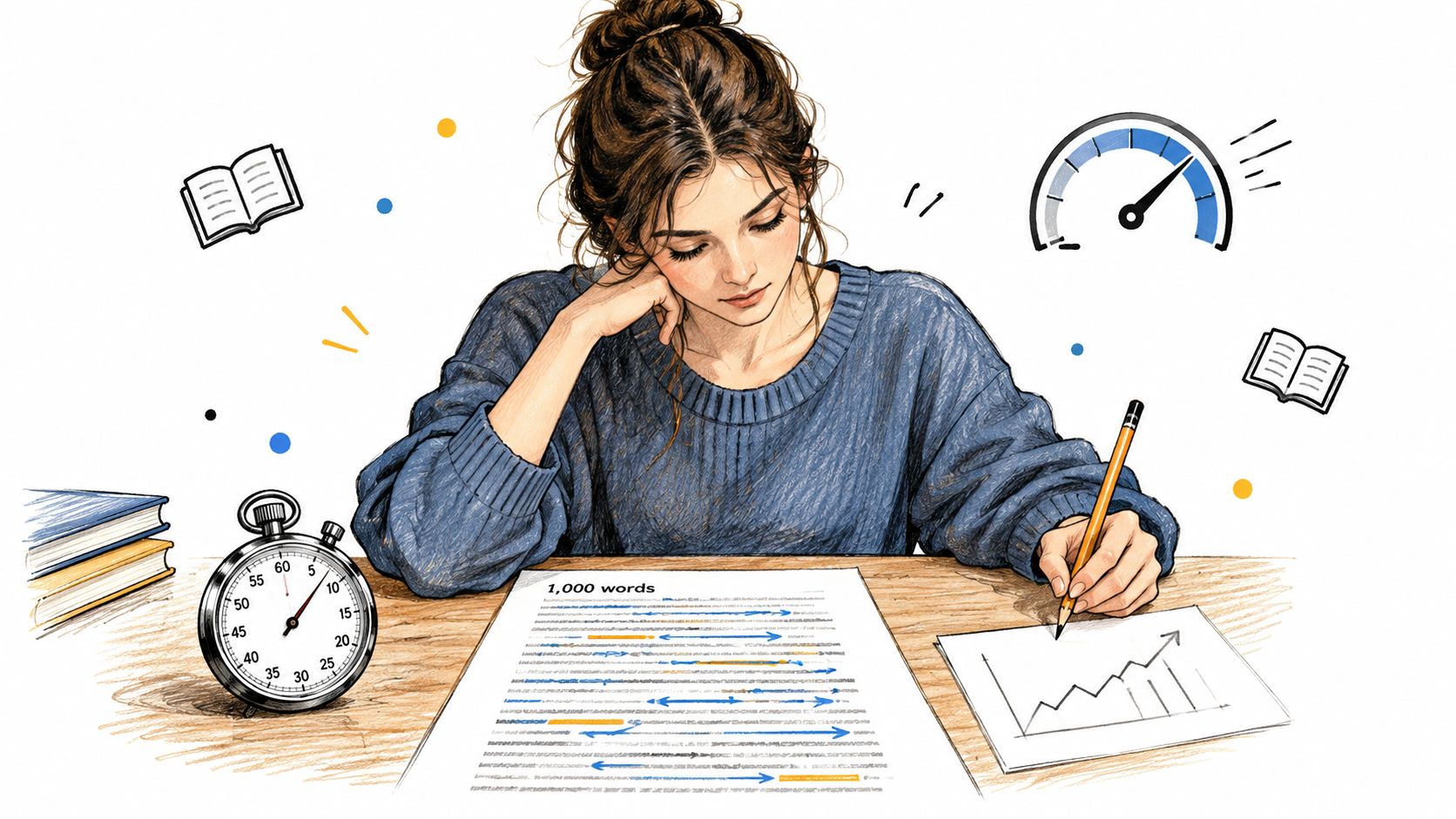
First, measure a representative passage. Use the baseline method with a 1,000-word section and questions that test both facts and inference. For example, ask what the author recommends, what evidence they use, and why that evidence supports the conclusion. Keep your answers so you can compare later sessions with something concrete.
Next, add a modest pace increase. Try approximately 5–10% per session, with a finger, index card, or on-screen guide if it helps you maintain direction. These are practice settings, not guaranteed improvement rates. The RSVP study involving 209 participants found no significant comprehension difference between 250 and 350 wpm, but significantly reduced comprehension at higher speeds; the baseline passage and incremental protocol provide a cautious way to apply that trade-off.
RSVP presents words sequentially, so its results don’t prove that a pointer will produce the same outcome in a book. Use the guide as an experiment. Drop it if tracking the guide takes attention away from the meaning.
A visual demonstration can give you ideas to test, but your own comprehension results should determine what you keep.
Test the gain and set a stopping rule
Then interrupt the drill for active recall. After short reading intervals, look away from the page and explain the argument, its evidence, and unresolved terms. Don’t settle for remembering the topic. Being able to say that a chapter concerns leadership isn’t the same as explaining the author’s recommendation.
Finally, compare and adjust. Check your answers against the passage and your baseline performance. Look for specific losses:
- Missing qualifications: You recall the recommendation but forget the conditions under which it applies.
- Broken reasoning: You remember a conclusion without knowing how the author reached it.
- Confused details: You mix up examples, characters, causes, or sequences.
- Empty fluency: Reading felt smooth, but you can’t produce a meaningful explanation.
If those errors increase, return to the last reliable pace. Don’t keep accelerating to prove you can tolerate discomfort. The drill succeeds when you find a sustainable setting for a particular kind of text, including when you discover that the current material needs slower reading.
Matching Your Pace to the Book in Your Hand
Finishing a thriller on a flight and rereading a research paper before a discussion aren’t equivalent tasks. In the thriller, you may want momentum and enjoyment. In the paper, you may need to distinguish the findings from the author’s interpretation.
Set your pace by asking what you’ll need to do afterward. Follow the plot? Explain a concept? Perform a procedure? Challenge an argument? The answer determines how much precision you need.
Recommended Pace by Text Type
| Text type | Recommended pace | Primary method | Comprehension check |
|---|---|---|---|
| Fiction | Fluid through familiar action, slower for complex or meaningful scenes | Continuous reading with selective pauses | Explain what changed and why a character acted |
| News | Quick overview, deliberate reading of relevant details | Scan structure, then examine claims and qualifications | Separate the event from interpretation |
| Textbooks | Deliberate for new concepts, brisker for familiar review | Preview, read, then work through examples | Explain the concept or solve a related problem |
| Technical documentation | Targeted navigation, careful execution | Search for the relevant procedure, read prerequisites closely | Describe the required steps and failure conditions |
| Complex nonfiction | Variable, slower at reasoning bottlenecks | Follow claims, evidence, objections, and conclusions | Reconstruct the argument and its limitations |
These are qualitative pace recommendations, not universal speed targets. A familiar textbook chapter may be easier for you than a novel with shifting narrators and an unfamiliar setting.
For fiction, don’t assume dialogue is disposable or description is padding. A short exchange can change a relationship; a setting detail can explain a later decision. Move briskly where you’re following comfortably, but slow down when you’re uncertain about motive, chronology, or viewpoint.
For news, scanning can help you decide whether a piece deserves attention. Once it does, inspect attribution and qualifications rather than treating the headline as the whole account. If you’re using the information to make a decision, read the relevant detail.
Recognize the point where speed stops helping
In a textbook, stop when you can repeat a definition but can’t use it. In technical documentation, don’t skim a prerequisite because it appears before the procedure you searched for. In complex nonfiction, pause when the author moves from evidence to a conclusion you can’t yet justify.
Read faster through what you understand. Read more carefully through what your next decision depends on.
A research paper you’ve read before may allow rapid navigation to the passage you need, followed by close inspection. That’s efficient reading, even if the key paragraph takes considerable time. You don’t have to maintain a constant pace to finish the task well.
Reading Faster on Screens Without Losing Focus
Before training your eyes, examine what else is competing for your attention. A reading session that includes messaging, tab switching, and repeated interruptions isn’t a clean test of your reading ability. You’re measuring reading mixed with other tasks.
A 2025 meta-analysis of attentional interference in networked digital environments, covering 124 experiments across 32 studies, found reduced comprehension with an overall effect size of Hedges’ g = -0.64. That supports addressing interruptions before blaming your pace.
Prepare the screen for a single task
Open the chapter or document before you start, and make unrelated activity inconvenient. The broader question of whether technology is making our attention span shorter is relevant, but you don’t need to settle it to change your next reading session.
- Silence interruptions: Disable notifications and put messaging apps out of immediate reach.
- Simplify the page: Use reader mode where available, or a clean document view instead of an ad-filled page.
- Separate research from reading: Save nonessential links for later rather than following every reference immediately.
- Adjust the display: Choose comfortable text size, spacing, and contrast instead of squeezing more words onto the screen.
- Protect a focused block: Decide what you’ll read before checking email or returning to other work.
Reader mode isn’t a reason to discard important evidence. If a figure, footnote, or linked document is necessary to understand the claim, keep access to it. Remove distractions, not the material you need.
Choose a medium you can use effectively
Print, an e-reader, text-to-speech, and audio are options to test, not a hierarchy of serious and unserious reading. Choose according to the task and your needs.
If you need to compare distant passages, try a format that lets you move between them comfortably. If sustained visual reading is difficult, test spoken delivery while retaining access to the text for terminology and references. For an audiobook, use bookmarks where you’ll need to revisit an argument.
Accessibility belongs in the reading plan. A reader with dyslexia or ADHD-related reading difficulties shouldn’t have to make eye-speed drills the entry requirement for finishing a book. Text-to-speech is worth testing against the same practical standard as silent reading: can you explain and use the material afterward?
Don’t assume faster playback means faster completion with understanding. If you repeatedly rewind, lose names, or miss qualifications, change the setting or medium. Sometimes the most useful improvement is a less interrupted session, not faster word delivery.
Three Speed-Reading Myths Worth Retiring
Some advice sounds convincing because it offers a visible action: silence your inner voice, force a target, or skip more words. The problem is that performing an action isn’t proof that you’re reading more effectively.

Don’t turn a technique into a universal rule
Eliminating subvocalization isn’t a complete strategy. Don’t spend the session policing whether you hear words internally. A more useful coaching priority is following meaningful phrases and anticipating the author’s direction.
Eye-movement research on faster and slower readers found rates of about 330 wpm versus 200 wpm, with the advantage associated with wider perceptual span and forward inferences rather than a single technique. That’s not a license to force your eyes to absorb a whole line at once.
A fixed target doesn’t fit every passage. A timer can help you compare similar tasks, but it shouldn’t dictate how you read an unfamiliar explanation. In research on rapid serial visual presentation and encoding, comprehension suffered when presentation exceeded ordinary reading rates. Rapid exposure isn’t equivalent to successful learning.
Selectivity isn’t random omission
The final myth is that you can safely skip words because only the obvious keywords matter. A qualification, negation, or transition can change the meaning of a passage. Skimming deliberately for an overview is different from omitting words while claiming full comprehension.
Use selective attention more carefully:
- Skip by purpose: Bypass an irrelevant section when you only need a particular answer.
- Read relationships: Attend to how claims connect, not just prominent nouns.
- Mark sparingly: Avoid highlighting whole passages as a substitute for deciding what matters.
Highlighting can help you locate material later. It doesn’t demonstrate that you understand it. Keep the marks useful, and let your explanation show whether the reading worked.
Your Personal Reading-Speed Plan
Keep your plan small enough to use beside an actual book. You don’t need a complicated tracker or a new reading app. A notebook entry with the book, purpose, reading mode, timing result, and recall notes is enough.
Use the checklist as a reminder, not another task to perfect before you begin.

Build a starter routine around real reading
Start with your baseline record and choose a mode for the next chapter. Practice the controlled drill on suitable material, then use the text-type table to decide where that pace belongs. Prepare your reading environment before opening the timer.
Don’t treat every session as training. Some sessions should be reading for pleasure or working carefully through difficult material. You’re building flexibility, not trying to convert every book into a speed test.
If postponing the session is the main obstacle, use practical ways to stop procrastination to make starting easier. Leave the book ready, identify the next passage, and remove the need to decide what to read when you sit down.
Review what the practice actually changed
At a regular review, look for useful patterns rather than a single best result.
- Keep what transfers: Retain techniques that help with the books you read.
- Separate your results: Don’t compare easy fiction with unfamiliar technical material as though they were the same test.
- Investigate setbacks: Check difficulty, interruptions, and fatigue before assuming you’ve lost progress.
- Make the next adjustment: Change the pace, method, or medium according to the specific problem.
Your governing metric remains recall after the section. A book finished quickly but poorly understood may require substantial work later. A flexible reader knows when to move on, when to pause, and when a deliberate reread is the most efficient choice.
Socialite Spaces offers practical guides on everyday habits and technology, alongside book reviews and cultural commentary. Visit Socialite Spaces for ideas that help you protect reading time, choose useful tools, and get more from the books you finish.